The First Africans

-
Select format
-
- Publisher:
- Cambridge University Press
- Publication date:
- 05 June 2012
- 23 June 2008
- ISBN:
- 9780511817830
- 9780521847964
- 9780521612654
- Dimensions:
- (228 x 152 mm)
- Weight & Pages:
- 0.94kg, 622 Pages
- Dimensions:
- (228 x 152 mm)
- Weight & Pages:
- 0.82kg, 622 Pages
You may already have access via personal or institutional login
Show more authors 
You may already have access via personal or institutional login
Book description
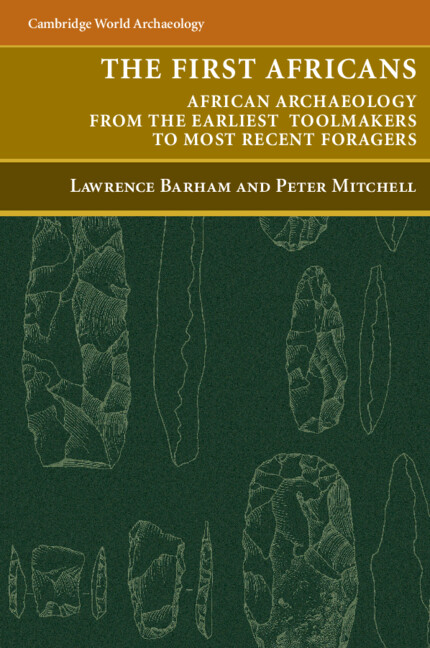
Africa has the longest record - some 2.5 million years - of human occupation of any continent. For nearly all of this time, its inhabitants have made tools from stone and have acquired their food from its rich wild plant and animal resources. Archaeological research in Africa is crucial for understanding the origins of humans and the diversity of hunter-gatherer ways of life. This book is a synthesis of the record left by Africa's earliest hominin inhabitants and hunter-gatherers, combining the insights of archaeology with those of other disciplines, such as genetics and palaeo-environmental science. African evidence is critical to important debates, such as the origins of stone tool making, the emergence of recognisably modern forms of cognition and behaviour, and the expansion of successive hominins from Africa to other parts of the world.
Reviews
"...probably the best available survey of prehistoric Africa. Recommended." --Choice
"It is apparent that this book represents an impressive scholarly achievement...Without a doubt this is an important book."--Graham Connah, School of Archaeology and Anthropology, Australian National University, Canberra, Australia
Contents
Contents
Metrics
Altmetric attention score
Full text views
Full text views helpTotal number of HTML views: 0
Total number of PDF views: 0 *
 Loading metrics...
* Views captured on Cambridge Core between #date#. This data will be updated every 24 hours.
Usage data cannot currently be displayed.
Accessibility standard: Unknown
Why this information is here
This section outlines the accessibility features of this content - including support for screen readers, full keyboard navigation and high-contrast display options. This may not be relevant for you.
Accessibility Information
Accessibility compliance for the PDF of this book is currently unknown and may be updated in the future.