Early talent is entering a job market that looks nothing like the one their predecessors faced, one that is not only impacted by economic headwinds, but reshaped by the rise of AI.
In the past year alone, the share of full-time job postings on Handshake that mention AI has nearly doubled, a clear signal that AI fluency is quickly becoming the baseline across industries.
Graduates are already taking stock of where they stand. In our most recent grad report, 58% said they'll need stronger AI skills to succeed at work, but only 28% said their academic program meaningfully prepared them for it. That 30-point gap is where the most driven students are finding room to pull ahead.
Many already are. The Class of 2026 is listing AI skills on their resumes at twice the rate of the Class of 2022, and 85% of seniors now use AI tools, with more than a third using them daily. Even more exciting: more students are moving beyond using AI to actually building with it.
This spring, Handshake and OpenAI launched the Codex Creator Challenge to meet that moment, putting the tools directly in students' hands.
Together, we gave students across the country free access to Codex, OpenAI's coding agent, along with the opportunity to build, showcase, and validate AI skills through actual work. Winners took home a year of ChatGPT Plus and up to $10,000 in OpenAI API credits.
We also brought the Challenge to life in person, hosting events at UC Berkeley and CSU East Bay, where students came together to go from idea to working prototype in a single afternoon. Each event included an OpenAI-led Codex walkthrough, a full-room build sprint, and employer spotlights from companies like GEICO, Uber, and Sikich on how AI is shaping early-career hiring. Across both events, more than 200 students showed up, built something, and left with work they could put on their Handshake profile.
“Working with OpenAI to launch the Codex Creator Challenge gave us a front-row seat to something we don't always get to see: a generation that is learning and building in real time, on their own terms. The most forward-thinking employers already understand what that means for hiring and are building talent pipelines around it. That's the intersection Handshake was built for, and this challenge put it on full display.” - Jonathan Stull, COO & President at Handshake
What students built surprised us
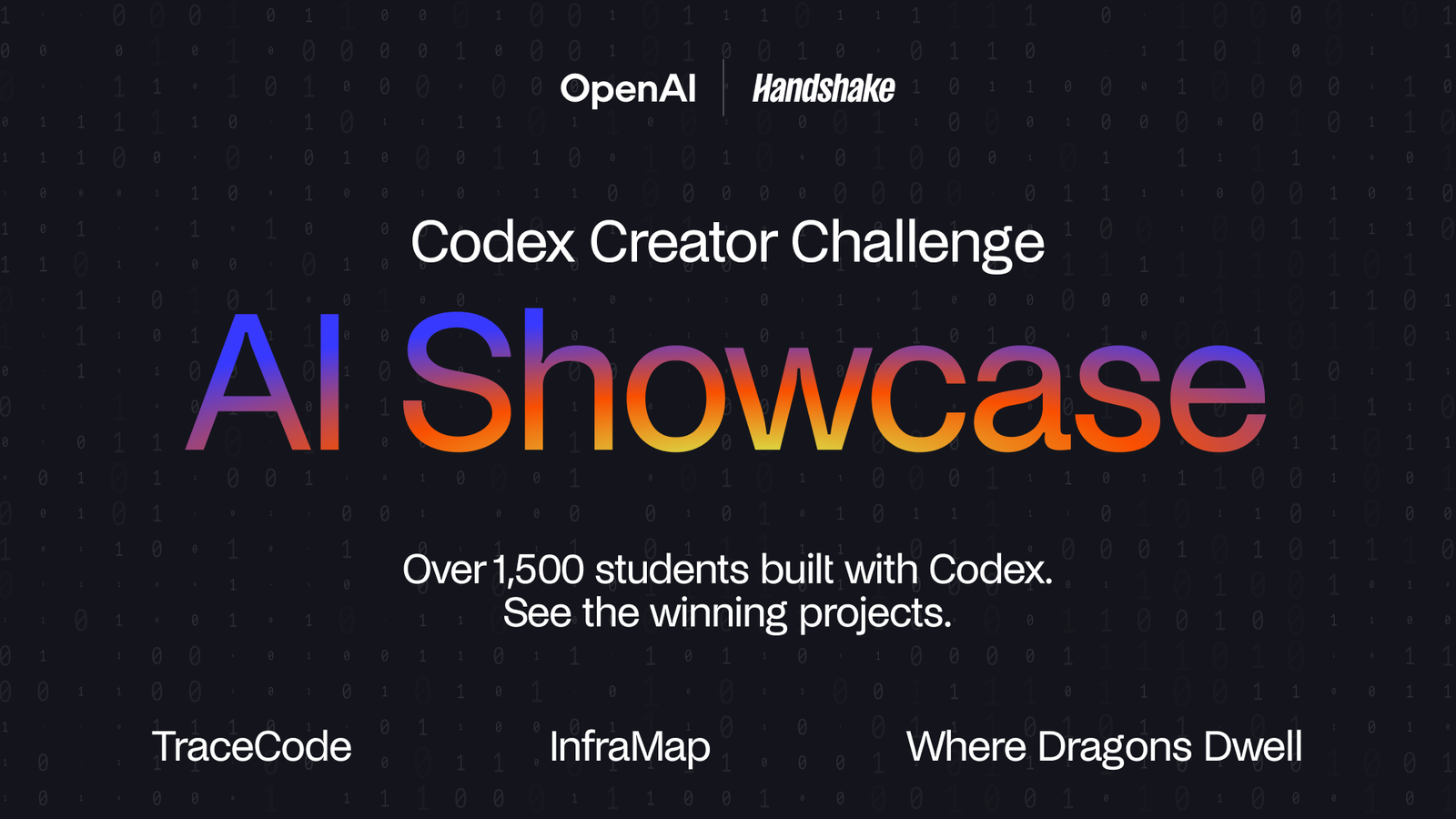
More than 1,500 students built and submitted projects, and the range of who showed up was one of the first things that stood out. We received submissions from MIT and UC Berkeley to the University of Louisiana at Lafayette and Wake Technical Community College. Nearly half came from students in non-technical fields like business, marketing, psychology, economics, biology, political science, and more.
The assumption that "AI builder" means "computer science major" simply didn't hold up.
The projects spanned every corner of student life — campus, community, and career. Students built tools to make sense of dense lease agreements, navigate student loans, consolidate notes and build study guides, share campus resources, and catch costly mistakes at work.
Our three winners are proof of that range:
- 1st place | TraceCode, by Obinna Nwachukwu (Georgia Institute of Technology).TraceCode helps CS students see why their code fails line by line, in real time.
- 2nd place | InfraMap, by Leonard Alsleben (Boston College). InfraMap turns paywalled energy data into an interactive atlas anyone can explore.
- 3rd place | Where Dragons Dwell, by Huiying Chung (Arizona State University). Where Dragons Dwell stitches dragon myths from 14 world cultures into one universal narrative.
Three students, three completely different majors, three projects no one assigned them. They just built. Check them out below:
“Preparing students for the future of work is not just about AI fluency. It is about helping students build agency: the confidence to ask better questions, create new things, and use technology to solve real challenges. The OpenAI x Handshake Codex Creator Challenge gave students a pathway to practice this. My hope is that one day building and creating with technology become a core part of higher education, not something students have to fit in outside the classroom.” – Leah Belsky, VP of Education, OpenAI
The skills employers are building their teams around
We were fortunate to work with an exceptional group of employers who went beyond lending their names to this challenge and showed up as judges, putting time into evaluating student submissions. Thank you to JPMorganChase, ZS, GEICO, Uber, Sikich, Salesforce, UBS, KPFF, and L'Oréal.
Projects were scored by the people closest to the work, senior AI practitioners and engineering leaders who build and hire for AI teams every day. The panel evaluated on clarity, usefulness, creativity, execution, and polish.
Employers approached judging as more than simply evaluating projects. GEICO's VP of AI joined us and OpenAI at UC Berkeley to provide direct feedback and guidance to students. L'Oréal opened its 2027 internship applications early to students who took part. For many, the challenge was as much about finding the next generation of AI talent as it was about recognizing it.
This is just the beginning
The Codex Creator Challenge came down to a simple idea: give students access to the right tools, and get out of the way.
If you're a student wondering where to start, the barrier to entry is lower than you think. With Codex, you describe what you want to build in plain language, and it helps you bring your vision to life, no experience required. The OpenAI Academy is a great first step. Whatever you make, you can showcase it on Handshake’s AI Showcase and your profile, where employers are already looking for these skills.
This is what Handshake is here for, helping anyone learn, earn and grow in the AI economy.