
36 Famous Authors Co-Wrote a Pandemic Novel. Can You Guess Who Drafted Each Section?
Margaret Atwood, R.L. Stine and John Grisham are among the writers who collaborated on “Fourteen Days,” which follows a group of New Yorkers who gather on a Manhattan rooftop to swap stories beginning in March 2020
/https://tf-cmsv2-smithsonianmag-media.s3.amazonaws.com/accounts/headshot/Catherine_Duncan_headshot.png)
/https://tf-cmsv2-smithsonianmag-media.s3.amazonaws.com/filer_public/b6/28/b628cb35-7356-4e46-b74e-8cf105f70316/gettyimages-1225701204.jpg)
Three dozen literary giants have joined forces to craft Fourteen Days, a collaborative novel set in the beginning of the Covid-19 pandemic. Each author was responsible for one character’s story, though no bylines appear throughout the text. To find out which writer pairs with each character, readers will need to flip to the end.
The project is the brainchild of Douglas Preston, the renowned thriller writer and former president of the Authors Guild, which commissioned the work. All proceeds from the novel, which debuted this month, will go toward the organization’s activities.
Fourteen Days takes place in New York City over a two-week period beginning on March 31, 2020. It is a time capsule of an unsettling era when lockdowns had just started and city-dwellers were clanging pots and pans to support first responders.
The story follows a group of tenants cooped up in their Lower East Side apartment building who gather on the roof every night. They begin to form a connection for the first time—even though they’ve lived on top of each other for years. Preston wrote the novel’s frame narrative, which unifies the patchwork of stories via the apartment building’s superintendent, Yessenia Grigorescu.
“Many years ago, I had this idea of writing a plague novel, sort of like Boccaccio’s Decameron,” Preston tells the Los Angeles Times’ Bethanne Patrick. “And it was a disaster. It was terrible! When you’re a novelist, you often abandon things, and I abandoned it. But when the pandemic hit, I thought it might be an idea worth resurrecting as a group storytelling project. I suggested it to a few colleagues, and they said, ‘Yes, let’s do it,’ but we have to tell the stories of the people who were left behind.”
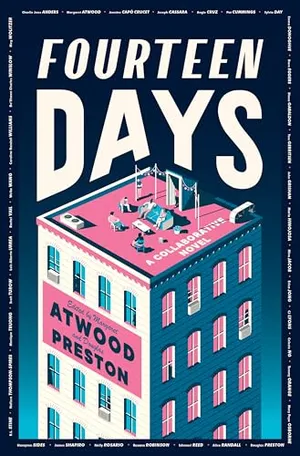
Fourteen Days: A Collaborative Novel
Set in a Lower East Side tenement in the early days of the COVID-19 lockdowns, Fourteen Days is an irresistibly propulsive collaborative novel from the Authors Guild, with an unusual twist: each character in this diverse, eccentric cast of New York neighbors has been secretly written by a different, major literary voice—from Margaret Atwood and Celeste Ng to Tommy Orange and John Grisham.
Preston enlisted Margaret Atwood, the award-winning author known for The Handmaid’s Tale, to co-edit and contribute writing to the novel. The 36 American and Canadian authors—including Celeste Ng, John Grisham, Tommy Orange, Meg Wolitzer, Charlie Jane Anders and R.L. Stine—each submitted a story that was then edited into Preston’s larger work.
“Margaret Atwood is a great friend of the Authors Guild, and she recruited the authors,” Preston tells the Marin Independent Journal’s Stuart Miller. “She’s such a towering literary figure that everyone responded.”
One of the authors, Emma Donoghue, jumped to join the project before she even “finished reading the first paragraph” of the pitch, as she tells CNN’s Zara Khan. The authors were not given any directions other than that they needed to write in the first person. And though the authors’ names lining the book’s cover are familiar, their exact contributions remain unknown until the very end of the novel, where each writer’s bio reveals which story they wrote.
“It’s a rare experience to get to write a bit of a book and then experience it as an unprepared reader,” Donoghue tells CNN.
The individual stories in the novel vary in length, style and genre. For example, one tale depicts a “spiky-haired bedbug exterminator who claims she used to be a spider,” per the New York Times’ Alexandra Jacobs. Another follows a nun who can predict exactly when a patient is going to die.
“We all have different stories in New York, and we all live on top of one another,” Stine, best known as the author of Goosebumps, tells the L.A. Times. “And we all get along pretty well. That’s what America is supposed to be about.”
While each narrative is unique, Preston thinks they all converge around a common theme: how storytelling can help establish community amid loss and isolation.
“In every human culture on earth, storytelling is a central part,” Preston tells the Marin Independent Journal. “It’s embedded in our very genes. We tell stories to make sense of tragedy, of war, of violence, of pandemics. We tell stories to make sense of a terrifying and senseless world. And that’s what this book is really about.”

A Note to our Readers
Smithsonian magazine participates in affiliate link advertising programs. If you purchase an item through these links, we receive a commission.
/https://tf-cmsv2-smithsonianmag-media.s3.amazonaws.com/accounts/headshot/Catherine_Duncan_headshot.png)