Showing posts with label collecting. Show all posts

10.25.2022

Jeremy's Vintage Jack-O-Lantern Collection

I've known Jeremy Lambertson for almost a decade now. He was a frequent reader of this blog and later joined the Martha Moments Facebook group where he became a contributing member. I met Jeremy, in person, for the first time this year at Martha's Great American Tag Sale in late April and it was nice to finally connect. 

Jeremy is a great cook and a wonderful baker, but his real passion is collecting. In fact, he's the most prolific collector I know. While he collects all manner of objects, including china and furniture, his real passion is collecting vintage holiday items, particularly Christmas and Halloween. 

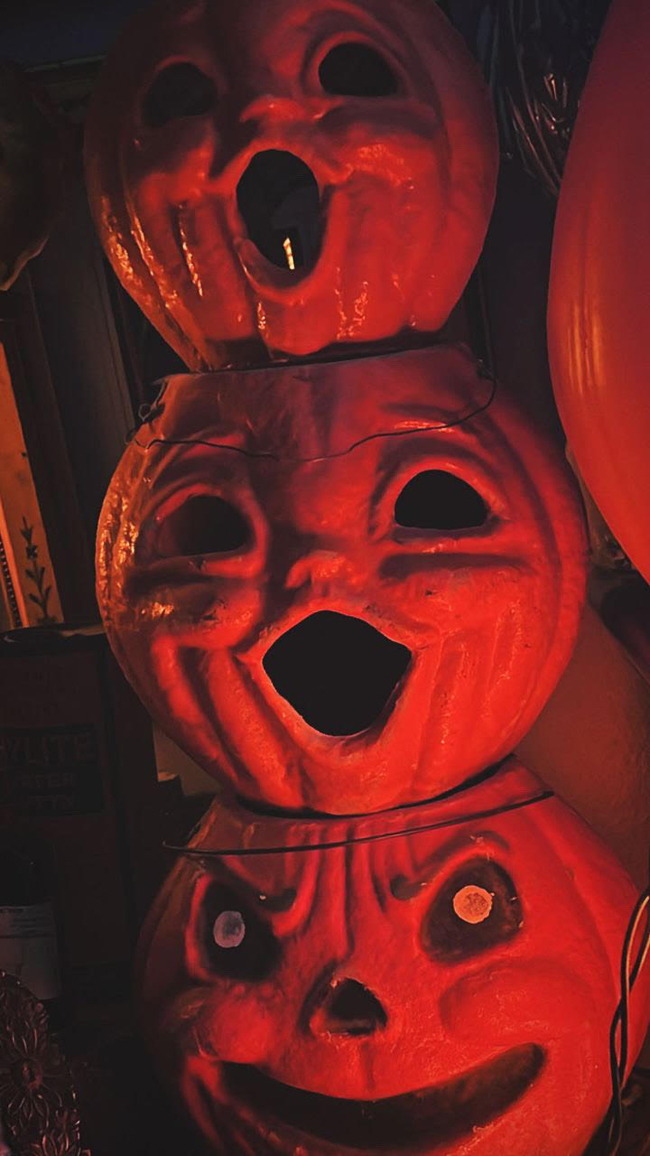
When I saw Jeremy's Instagram stories recently, featuring his extensive vintage Jack-O-Lantern collection, I was inspired to do this blog. He perhaps has one of the largest vintage and antique Halloween collections in North America. What I love most, though, is that every year he brings everything out for display, filling the rooms of his house with his hard-won treasures. 

Most of the Jack-O-Lanterns in his collection were made in the United States between 1930 and 1960. They are quite rare, mainly because they were not mass produced and because they were primarily made of soft materials, such as papier-mache and paper pulp. Many of the examples from that time period were irreparably damaged by water, breakage or fire. As a result, those that did survive the rigors of time and the elements are quite valuable. I had a little chat with Jeremy recently about his collection. I hope you enjoy his collection as much as I do!

1. What do you look for when collecting vintage Jack-O- Lanterns?

I look for what catches my eye. Also I don’t mind collecting multiples of the same jack-o’-lantern because I feel more of them together creates interest and a certain wow factor. There are some that are very hard to find, for example the pumpkin man is rare and I was lucky enough to find one this year. 

2. What is their level of collectability?  

They are very collectible! Halloween was seen as disposable during the 1940s and '50s and not collectible at all when all these were made. People rarely saved their Halloween decorations. Also, these pumpkins were meant to hold candles and they are paper pulp so as you can imagine many 
caught fire, and if they got wet, from the rain for instance, they just disintegrated, so that makes them hard to find. Vintage Halloween is much harder to find than vintage Christmas, and it usually costs more.

3. What can a collector expect to pay for a good specimen?

For a small pumpkin you can expect to pay between $80 and $190 and for the larger common ones around $125 to $380. For the rare examples, or those made in Europe, expect to pay $350 to $1500+.

4. What are some of the best places to shop for these rarities? What states? What shows or stores?  

I shop everywhere: estate sales, online, yard sales, antique shows and flea markets. Recently this past July I attended Brimfield in Massachusetts, a huge week long show. And I found the most Halloween I’ve ever bought. I believe I bought 19 paper pulp pumpkins that week.
5. Your displays are so captivating! How do you make them so appealing? 

I like to say you gotta stack and pack a display; when you think it’s done, add more! I feel it’s never done. I move things all the time. But I do like to have similar colors together and usually a theme. For example, I’ll put all the vintage Halloween candy boxes together and all the costumes together. Also since I collect year-round I always have new stuff to add to the next year's collection and that keeps it fresh.

6. How do you typically store your Halloween collections and what considerations would you suggest people keep in mind when storing their own collections?

I keep everything in clear totes, stored in the basement with a dehumidifier. I also put the silicone bees in each of them, that way they suck up any moisture. Remember, these are paper pulp just like egg cartons so you can imagine how fragile they are and susceptible to moisture damage, given their age, some dating back to the late 1930s . I don’t over crowd the totes and package similar items together so they're easy to find next year.

Jeremy lives in Cincinnati, Ohio, and is the caretaker of two elderly sisters, Emma and Gloria. He has several booths at the Ohio Valley Antique Mall where he sells many of his treasures. Be sure to visit if you're in the area. Jeremy is also currently restoring an early nineteenth century Federal farm house on 13 acres about an hour from his home. 

Happy Halloween!

10.23.2017

The New Book on Wedgwood

Anyone interested in Martha Stewart is surely interested in Wedgwood. Martha has extensive personal collections of Wedgwood ceramics and chinaware and has worked with the brand over the years to create her own lines of Martha Stewart drabware and fine-bone china, which she sold through Martha by Mail, her former catalog business, and Macy's department store. Many of us remember her informative television segments that extolled the virtues of this 250 year-old brand. Some of us, too, may remember some of our grandmothers' or parents' Wedgwood pieces, perhaps cobalt-blue ceramic tea cups with white relief patterns, perched on a shelf in the dining room cabinet, or ceramic vases or coasters or jewelry boxes.
Wedgwood has just released its first ever coffee table book, pulling together the vast history of its archives with some of its most innovative and modern collections. "Wedgwood: A Story of Creation and Innovation" was produced by Rizzoli and is a beautiful tome with full-colour photographs of some of the company's finest examples, old and new. Author Gaye Blake-Roberts tells the full story of the Wedwood firm, from its inception in 1759 in England to its present-day incarnation as an emerging lifestyle brand.

Wedgwood, now owned by Finnish housewares brand Fiskars, is embarking on a revitalization campaign to make Wedgwood more appealing to younger consumers. By working with young designers, such as Lee Broom, and bringing a new sense of modernity to the designs (without sacrificing the prestigious heritage collections or the time-honoured manufacturing techniques), the company is attempting to fuse current lifestyle trends with a 300 year-old history of traditional craftsmanship. It's quite exciting!
Young British designer Lee Broom, shown above, was enlisted by Wedgwood to design a modern collection of Jasperware pieces.


Wedgwood has also commissioned a new line of teas with exotic blends from around the world.

I highly recommend watching this panel discussion with the author of the book, Gaye Blake-Roberts. She is joined on stage by designer Lee Broom and Fiskars senior vice president, Eva Ziegler, at the Victoria & Albert Museum in London, represented in the discussion by V&A Director Tristram Hunt. Click the highlighted link above and scroll down to find the video.

The new book is gorgeous and is essential for any Wedgwood collector or anyone interested in the brand, in ceramics or British history. Below are some photographs from the book.
The book is in stores now and can also be ordered on Amazon.

6.30.2015

Good Thing: A Beach-Stone Basket

Every summer as a boy, my parents would take us to the seaside. Whether it was Nova Scotia, Prince Edward Island, British Columbia, Florida or Maine, I can scarcely recall a summer when I didn't have an adventure with my family by the sea. My father is something of a beachcomber and we would always find room in our trunk for a little bucket of the beautiful stones that he would find on his walks along the beach. Over the years, with more and more trips, this collection began to expand. Several years ago my parents decided to place all of their collected beach stones in a basket and display them in their living room. In addition to the places mentioned above, the basket now contains beach stones from New York, Scotland, England, Puerto Rico and France.
Tip: Look for stones with unusual markings and details. To enhance these marking, my father applied a light coating of varnish to some of the rocks to help them maintain that shiny, wet look. This drastically improves the appearance of the markings and special details. Once coated, let the stones dry on a wire rack for at least 24 hours before placing them in any sort of vessel.

5.11.2014

Domestic Insight: Kitchenware Icons

Recent trips to several flea markets and consignment shops have given me pause to ponder my love of vintage kitchenware. Swooping down like a magpie, I can’t seem to resist the mid-century modern designs and patterns that conjure up all kinds of nostalgia for me: memories of my grandmother mixing cake batter in her big Pyrex bowls, or her huge cast-iron pots on the stove coated in enamel in shades of avocado and popsicle-orange. It seems I’m not alone, either. Numerous friends of mine in the 30-something demographic are obsessed with these design icons of the past, snapping them up where and when we can for use in our own kitchens. I’ve selected five of my favourite vintage kitchenware brands and styles and have gathered some interesting information about their origins for this month's Domestic Insight column. What are some of your favourites?
PYREX: Pyrex glassware was introduced to the American public in 1915 by Corning Glass Works. Today, there are three types of collectible Pyrex: Clear Pyrex Ovenware (introduced in 1915), Pyrex Flameware (1936 – 1979) and Pyrex Colors, which began production in 1947. Of these three types, most people are familiar with the Pyrex Colors collection because of its distinctive hues and folky patterns. Pyrex is still manufacturing modern cooking products but the vintage pieces are also relatively easy to find, due in large part to its enormous popularity. Its widespread availability, affordability, durability and the variations in its attractive designs made it a universally appealing. Chances are good that your mother, grandmother or aunt may have a few vintage examples in their kitchens! Examples of vintage Pyrex are easy to find at flea markets and antiques shops, and through online auction sites, such as Ebay.CATHRINEHOLM: Cathrineholm was an ironworks, located near the town of Halden in Norway, which started production in 1907. Originally the ironworks manufactured wrought iron products and agricultural equipment, but due to changing economic circumstances it later evolved into producing enamel kitchenware. The company closed in 1970.  Cathrineholm enamelware can be difficult to find and most people build up their collection by buying on Ebay. Even on Ebay, there can sometimes only be a handful of items up for sale at any one time. A useful tip when searching for Cathrineholm on Ebay is to be aware that a huge number of people spell it incorrectly - so make sure that you also search for Cathrineholme, Cathrinehome, Catherineholm, Catherineholme, Catherinehome, Catherine holm, Catherine holme, Catherine home etc! The vibrant colors and charming printed patterns on Cathrineholme pieces are what make it so collectible today. They are strikingly modern.DANSK KOBENSTYLE: Dansk Kobenstyle Enamelware was originally manufactured by the Danish company Glud & Marstrand, but by 1966 had been sold to a French manufacturer. The cookware is most often compared to the French cookware brand Le Creuset, although it is lighter and more modern. The most sought-after examples are of Danish origin, exhibiting Dansk's original "Four Ducks" logo.  The initials "IHQ" are the mark of Designer Jens Quistgaard. Among its unique features are the specially-designed lids, with criss-cross handles that can be safely lifted by a spoon and that allow a collection of cookware to stack beautifully. Lovers of this style of cookware will be delighted to know that it is being manufactured again in three colours: red, white and blue enamel. It was sold exclusively at Crate & Barrel at first, but other retailers have begun to carry it. Anthropologie has recently added it to its home product line.JADEITE: Personally, I find it difficult to think of Jadeite without thinking of Martha Stewart. Martha was an early champion of this now very-collectible form of pressed glass kitchenware and a portion of her personal collection is shown above, photographed in the pantry at Skylands, her home in Maine. Jadeite was made mostly during the 1920s and '30s and was popularized by the Jeannette Glass company in the 1930s as inexpensive Depression Era glassware. The term Jadeite refers to the colour (a milky, minty green) not a particular brand. A number of glassware companies in the U.S. and abroad made items in varying colors of Jadeite during this time period.  The types of Jadeite vary depending on the company that produced the item, and they are usually identified by company marks. Companies like McKee and Fire King made glassware in Jadeite and can be identified by their logos on the bottoms of the pieces. Many other companies, both from the U.S. and abroad, manufactured Jadeite and there are books available with more detail for collectors. Modern variations on Jadeite are currently made by several brands, including Martha Stewart, and are often hand-pressed using the original molds. For most collectors the color is the draw, although unique examples, such as hen-shaped casserole dishes, slender cake stands and unique salt-and-pepper shakers add to the allure.
RUSSELL WRIGHT: American industrial designer Russell Wright (1904 – 1976) was best known for his colorful ceramic and plastic dinnerware, manufactured between 1939 and 1959b y Steubenville Pottery in Steubenville, Ohio. Wright also designed furniture, spun aluminum dining accessories and textiles and is celebrated for his influential contributions to American-modern design. The simple, clean lines in his designs, saturated color palettes and sturdy practicality made his dinnerware highly sought-after by middle-class families eager to embrace the new, modern aesthetic. Even during the period of manufacture, his pieces were relatively costly compared to other brands, marketed to consumers who valued quality craftsmanship and design. Russell Wright collections are highly collectible today, due in part to the limited period of time his pieces were produced.

4.16.2014

Domestic Insight: Eggcups

When my brother and I would stay with my grandparents as children, we always looked forward to the breakfasts my grandmother would make for us. Often, that breakfast included soft-boiled eggs served in pretty eggcups with a little plate of ''toast fingers'' for dipping. I now have two of those eggcups in my kitchen cupboard and each time I look at them I remember those sunny mornings at my grandmother's dining room table. They are shown in the photo below.
They were made in the 1950s in England by Wood & Sons in the Clovelly pattern. My mother and my aunt also used these as children and they are very special to me.
 
Indeed, the collecting of eggcups is so popular today that it has been given its own name: pocillovy, which comes from the Latin pocillum ovi, meaning "a small cup for an egg." Eggcups have existed for centuries. The earliest known examples were unearthed at Pompeii but no individual has been credited with its invention. Their inception was no doubt due to the very difficult task of eating hot eggs cooked in their shells; they are unwieldy on plates and impossible to hold with bare hands. The design of the eggcup is brilliant in its simplicity and functionality, holding a cooked egg firmly upright. With the top of the egg shell removed, the egg can be scooped out with a small spoon and enjoyed at one's leisure.
 
Nearly every maker of dinnerware has designed a selection of eggcups. Wedgwood, Spode, Royal Doulton, Limoge, Fire King Jadeite, Catherineholm all produced (and still produce) eggcups. The materials used to make eggcups are just as varied as their makers: ceramic, porcelain, wood, plastic, glass and even silver. There are majolica eggcups, Fiestaware eggcups and ebony eggcups. Plenty for the pocillovist to choose from!
 
There are two basic kinds of eggcups: the single cup and the double cup. The single cup rests upon a decorative pedestal while the double cup can be inverted to offer two different cup sizes, either to accommodate a larger egg type, such as goose or duck, or to act as a serving dish for eggs that have been scooped out of their shells.
 
That the eggcup has been such a constant in the kitchens of families all over the world for centuries is not surprising. Their beautiful design and purpose ensures the eggcup will be around for a very long time to come. As long as there are eggs, there will be eggcups!
 
EGGCUP RESOURCES:
Click here to watch Martha discuss the history of eggcups.
Click here for a very comprehensive collection of links about eggcups and eggcup collecting.
 
Eggcups are not reserved for eggs only. They can serve many purposes, including acting as tiny vases. Spring flowers in pretty nosegays look lovely arranged in a collection of eggcups shown here. You could also use them to display spring bulbs or store small objects, such as safety pins, stamps or small pieces of jewelry, as shown below. (Photo Martha Stewart Living)
(Left photo by Skona Hem; Right photo by Midwest Living)
Three ironstone double eggcups date to the 1930s and '40s, shown top right. A novelty cup in treen (turned wood) is decorated with a cute painted face and holds a matching egg with a painted-on Orphan Annie hairdo. The single cup holding the blue egg has a plate attached and the one behind it is made of plastic and chrome with a removable lid. Silver luster stripes enhance a streamlined Art Moderne ceramic cup from the 1930s. (Photo Martha Stewart Living)
These beautiful Scandinavian, French and American examples of eggcups are extremely alluring with their darker tones. (The ivory-coloured eggcup shown at far left is actually made of white chocolate, formed in a rare eggcup chocolate mold.) The materials here include ceramic, porcelain, ebony and black glass. (Photo Martha Stewart Living)
In this photo a multitude of eggcup designs is shown, among them a milk-glass cup in the shape of a chick and a chick's head from the 1960s. The eggcup with the green stripe at the top is Japanese lusterware from the 1930s. The double-cup, far left, is by Wedgwood and top right is a cook-and-serve wire eggcup, also from the 1930s. My favourite is the eggcup with the two chatty peeps, made for the Fanny Farmer candy company. (Photo Martha Stewart Living)
During Victorian times, silver eggcups were extremely popular and were often given to children as Easter gifts or at Christenings. They are not very common today since the silver reacts to the sulphur of the egg, resulting in tarnish. Since silver is also a heat conductor, hot eggs would heat the eggcup, making it difficult to handle. As this photo reveals, however, chocolate eggs do very nicely in silver!

8.18.2013

Pitcher Perfect

On a recent visit to my parents' home, I discovered two beautiful antique pitchers I had never really noticed before. They both belonged to my great gandmother, who obviously had an eye for beautiful, unique objects. My mother recalls studying all the details in these pitchers as a child and, because of her early interest, she inherited them. The ceramic pitcher depicts a stork standing on a log with decorative lily pads around the base and a series of soaring tulips reaching to the opening of the jug. The stork acts as the pitcher's handle. The glass pitcher has an embossed branch motif with two squirrels frolicking amongst the leaves. Both pitchers were made in Canada in the early 1900s. The glass pitcher was manufactured at a glassworks in Carleton Place, Ontario, not far from where my great grandparents had a farm. Both are treasured family heirlooms and I wanted to share their beauty here.


7.31.2013

The Most Famous Spice Rack in the World

As spice racks go, few are more sensational than the antique example Martha had mounted on the wall of her television studio in Westport, Connecticut. Sleek and unobtrusive, it was characterized by its special step-like shelves that ascended from the longest on the bottom to the shortest on the top. Martha found it at an antique shop and it quickly became a fan favourite as viewers wrote in by the thousands to inquire about it. (Fun fact: its original purpose was to sort tobacco leaves!) To satisfy the interest, Martha commissioned two reproduction versions of the spice rack to be sold through Martha by Mail, her mail-order/online catalog. She sold the metallic spice tins to match: squat, round tins with pretty Martha by Mail labels denoting the spice found inside. These fit perfectly onto the shelves of the spice rack. There was a five-shelf version, which held 30 of these spice tins, and a larger version with seven shelves that held 70 tins. They were available in natural wood or painted "Atlantic Blue." They retailed for $169 and $359, respectively. Here is a photo of them from the catalog, below, followed by an example of the seven-shelf version with the original spice tins from the kitchen of David Pantoja, host of the Good Things by David blog and my go-to historian regarding all things Martha by Mail.
When the catalog folded, fans missed out on these beautifully special pieces. In the years since I began this blog (nearly 8 years ago, which is so hard to believe) I have made so many wonderful friends with the same interest in Martha's products, magazines, the history of her career and her company's development. Many of these friends were collectors of Martha by Mail merchandise and still others are new to the fold, but with a very passionate desire to attain some of these long-gone prizes from catalogs past.

One such person is Nick Stein, a Martha enthusiast and a reader of this blog. Nick is a young university student from San Lorenzo, California, who took it upon himself to recreate this spice rack. He was so impressed by the results that he began to make more. Nick makes them out of maple, oak, poplar, mahogany and cherry wood.

Here are a few words from Nick about the spice rack:

"Being a huge fan of jadeite gives me an interesting superpower. I can spot that milky green hue from a mile away. I don't even stop at garage sales, I do a drive-by, looking for that particular shade to catch my eye. This power was activated when I was watching an old episode of MSL. I saw some jadeite custard cups sitting on a very interesting spice rack. And from then on I knew I had to have that same rack. I scoured the internet and discovered Martha by Mail (I was late to the party) and David's blog Good Things By David. His post about the spice rack and its details made me realize that I could have one too! And I could build it! I used some computer software to draw up a plan and bought some lumber. I love the simple lines of this piece. It's so sturdy and heavy and functional. It totally cleaned out my horrid spice cabinet too! I now will make them for anyone that wants a piece of Martha by Mail in a style as true to the original as possible! I offer many wood types, painted or stained, and the spice tins as well including custom labels! Each piece is slightly unique and a lot of time is spent making it as perfectly as possible."
Melody Hofmann, another Martha Moments reader, purchased one of Nick's spice racks in natural maple. She photographed it in her crafts room (look at all those Martha Stewart punches and glitter!) but now has it in her kitchen filled with spices.
Nick's spice rack in natural and stained maple.

Nick's spice rack holds 30 tins.

5.20.2013

An English Heirloom for Victoria Day

Canadians celebrate Victoria Day today - a national holiday designated to honour the British monarch's birthday. Currently, that monarch is Queen Elizabeth, but it was Queen Victoria who reigned during Canada's confederation in 1867 and it was her birthday that the holiday was initially created for. It is not a particularly eventful holiday, aside from the occasional round of fireworks, but it is nice to have a weekday (especially a Monday!) to enjoy at home or outdoors with friends and family in the merry month of May. I decided to show you one of my Wedgwood treasures today, inspired by the jasperware image of the monarch and that deep royal blue it stands against. It is so classically Wedgwood and so perfectly English. This 'trinket box' is actually a cigarette holder that was given to my grandmother by her sister, who attended the coronation of Queen Elizabeth II in 1953, which is when this piece was made. It was given to me several years ago when my grandmother sold her large house and moved into an apartment. One side features an image of Queen Elizabeth II and the other depicts her husband, Prince Phillip. Although I don't smoke, I love this ceramic container and it could be used to hold any small objects. It is a little piece of commemorative royal history, right here on my mantel shelf. It is also a very nice reminder of my grandmother.

3.29.2013

Bunnykins

Having British grandparents meant having early exposure to a wide range of English traditions and collectibles growing up. One of my most treasured collections today is my little set of Bunnykins dishes that my grandmother gave to me on my first birthday. My mother kept the set safe for me - and she still has it at home today, stored carefully in her china cabinet. As a child, I do remember studying the plates and their whimsical drawings of happy-go-lucky bunnies leading charming lives in the English countryside. I may have had a bowl of Cheerios or two out of the cereal bowl! I remember my mom allowing me to use the set on special occasions.
 
Bunnykins china was introduced by Royal Doulton in 1934. It was designed primarily for children and it became a popular gift at Christenings and baby showers in middle-class English homes. The artwork is by Mary Barbara Bailey who was the daughter of Cuthbert Bailey, the general manager of Royal Doulton ceramics during the 1930s. Unbeknownst to the public, Mary was not a professional illustrator. She was a nun in the Augustinian Canonesses of the Lateran who developed her own artistic talent. Bunnykins tableware depicted Mr. and Mrs. Bunnykins and other rabbit friends dressed in human clothing in colourful, rural English settings. Picnics, doing laundry, apple-picking and reading stories by the fire were popular scenes portrayed on the Bunnykins dinnerware. When newsreels showed the china being used by Princess Elizabeth and Princess Margaret at Buckingham Palace it became wildly popular with the masses.
 
The Bunnykins pattern is still manufactured by Royal Doulton today and many china stores carry the line. Figurines are also available and any original examples of Bunnykins from the 1930s are highly valuable and rare.
 
If I had the proper space for it, I would have my Bunnykins set with me. Below are examples of the set I have. I thought they would be fun to share at Easter. (Incidentally, Martha Stewart used Bunnykins in one of her tablesettings in Entertaining... page 19.) Happy Easter, everyone!