I've known Jeremy Lambertson for almost a decade now. He was a frequent reader of this blog and later joined the Martha Moments Facebook group where he became a contributing member. I met Jeremy, in person, for the first time this year at Martha's Great American Tag Sale in late April and it was nice to finally connect.
Jeremy is a great cook and a wonderful baker, but his real passion is collecting. In fact, he's the most prolific collector I know. While he collects all manner of objects, including china and furniture, his real passion is collecting vintage holiday items, particularly Christmas and Halloween.
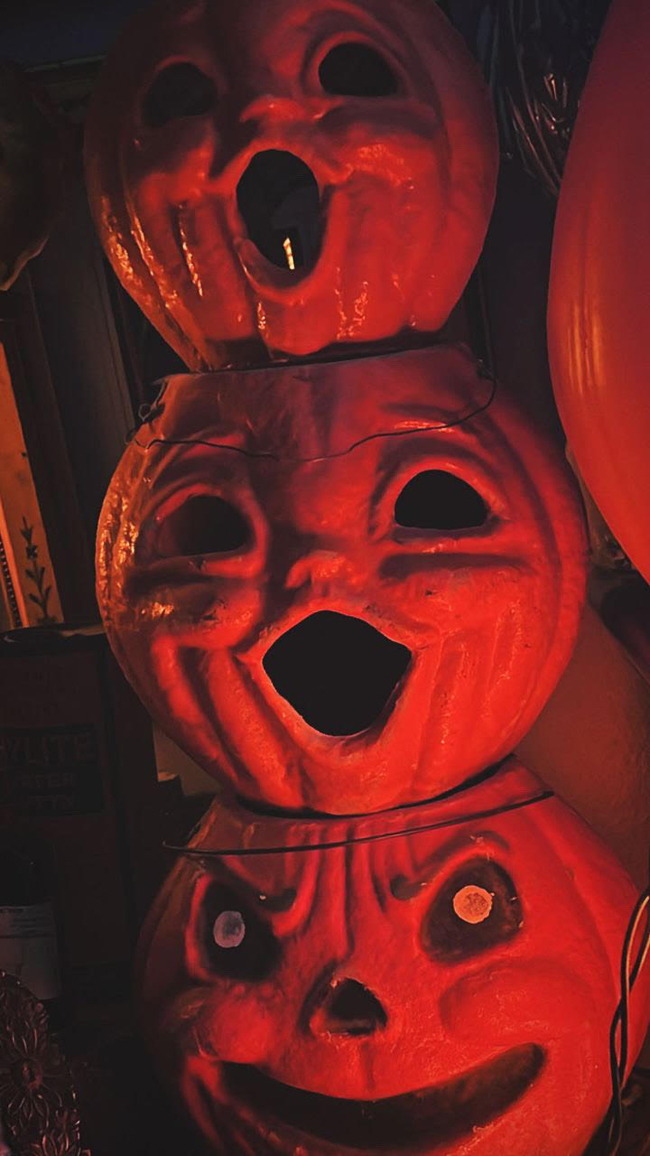
When I saw Jeremy's Instagram stories recently, featuring his extensive vintage Jack-O-Lantern collection, I was inspired to do this blog. He perhaps has one of the largest vintage and antique Halloween collections in North America. What I love most, though, is that every year he brings everything out for display, filling the rooms of his house with his hard-won treasures.
Most of the Jack-O-Lanterns in his collection were made in the United States between 1930 and 1960. They are quite rare, mainly because they were not mass produced and because they were primarily made of soft materials, such as papier-mache and paper pulp. Many of the examples from that time period were irreparably damaged by water, breakage or fire. As a result, those that did survive the rigors of time and the elements are quite valuable. I had a little chat with Jeremy recently about his collection. I hope you enjoy his collection as much as I do!
1. What do you look for when collecting vintage Jack-O- Lanterns?
I look for what catches my eye. Also I don’t mind collecting multiples of the same jack-o’-lantern because I feel more of them together creates interest and a certain wow factor. There are some that are very hard to find, for example the pumpkin man is rare and I was lucky enough to find one this year.
2. What is their level of collectability?
They are very collectible! Halloween was seen as disposable during the 1940s and '50s and not collectible at all when all these were made. People rarely saved their Halloween decorations. Also, these pumpkins were meant to hold candles and they are paper pulp so as you can imagine many
caught fire, and if they got wet, from the rain for instance, they just disintegrated, so that makes them hard to find. Vintage Halloween is much harder to find than vintage Christmas, and it usually costs more.
3. What can a collector expect to pay for a good specimen?
For a small pumpkin you can expect to pay between $80 and $190 and for the larger common ones around $125 to $380. For the rare examples, or those made in Europe, expect to pay $350 to $1500+.
4. What are some of the best places to shop for these rarities? What states? What shows or stores?
I shop everywhere: estate sales, online, yard sales, antique shows and flea markets. Recently this past July I attended Brimfield in Massachusetts, a huge week long show. And I found the most Halloween I’ve ever bought. I believe I bought 19 paper pulp pumpkins that week.
5. Your displays are so captivating! How do you make them so appealing?
I like to say you gotta stack and pack a display; when you think it’s done, add more! I feel it’s never done. I move things all the time. But I do like to have similar colors together and usually a theme. For example, I’ll put all the vintage Halloween candy boxes together and all the costumes together. Also since I collect year-round I always have new stuff to add to the next year's collection and that keeps it fresh.
6. How do you typically store your Halloween collections and what considerations would you suggest people keep in mind when storing their own collections?
I keep everything in clear totes, stored in the basement with a dehumidifier. I also put the silicone bees in each of them, that way they suck up any moisture. Remember, these are paper pulp just like egg cartons so you can imagine how fragile they are and susceptible to moisture damage, given their age, some dating back to the late 1930s . I don’t over crowd the totes and package similar items together so they're easy to find next year.
Jeremy lives in Cincinnati, Ohio, and is the caretaker of two elderly sisters, Emma and Gloria. He has several booths at the Ohio Valley Antique Mall where he sells many of his treasures. Be sure to visit if you're in the area. Jeremy is also currently restoring an early nineteenth century Federal farm house on 13 acres about an hour from his home.
Happy Halloween!