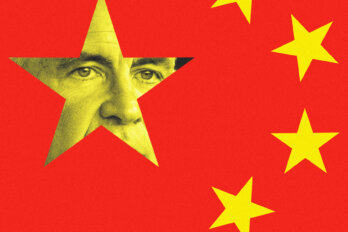
We need to ask, and actually answer, why Mark Carney is so popular. The simple explanations we keep giving ourselves—Donald Trump, Pierre Poilievre, the collapse of the Conservatives—explain part of it, but nowhere near enough.
Carney’s popularity has a different quality to it. Canadians don’t merely seem to prefer him to the alternative; they seem unusually reluctant to imagine replacing him at all, and that’s a much stranger political fact than the polls alone suggest.
The tariff shock did something to Canada that went well beyond economics or anger at the United States. It forced the country to look at itself more honestly than it had in decades, and what Canadians saw was unsettling: a country far more dependent, culturally porous, and psychologically uncertain than the confident version of Canada we’d been carrying around in our heads.
That shock opened an identity crisis. Canadians were forced to look directly at how small we are beside the United States. Canada is rich, geographically enormous, a G7 country, and a member of nearly every club that signifies importance, yet our neighbour has ten times our population, vastly more economic power, and enough leverage to disrupt Canadian life almost casually.
That was humiliating because it collided with the Canada we imagined ourselves to be. Canadians suddenly had to reconcile our sense of ourselves as an important sovereign country with the uncomfortable reality of how dependent, culturally porous, and strategically vulnerable we’d become.
That shock hit Canada harder than it could hit France, Japan, or Sweden. France can have a vicious trade dispute with Washington and still wake up unquestionably France the following morning; Japan doesn’t suddenly wonder whether Japanese identity exists independently of the United States.
Canada had a harder problem. Our institutions are British, much of our popular culture is American, our history is tied to Europe, Quebec carries a national identity of its own, Indigenous nations predate Confederation, and our modern population has been reshaped by immigration from every part of the world.
We’ve been extraordinarily successful at being a country without ever agreeing very clearly on what the country means. For a long time, that ambiguity was almost part of the national identity itself.
Then somebody shook the building, and we discovered that we cared whether it had foundations. The shock wasn’t simply that the United States could hurt us; it was that we suddenly had to explain to ourselves what exactly was being hurt.
“Elbows up” was the first reaction. Buy Canadian, cancel the Florida trip, take the bourbon off the shelf, and wave the flag, but those things couldn’t answer the deeper humiliation of suddenly feeling small beside the United States.
What Canadians needed wasn’t simply defiance. Psychologically, we needed weight, and we needed something grander than retail nationalism to provide it.
We needed to feel old when America made us feel temporary, important when America made us feel peripheral, and sovereign when America made us feel dependent. What had been injured wasn’t merely our economy but our sense of national significance.
And sitting there, almost embarrassingly unnoticed, was the monarchy. Canada had spent decades treating it like inherited furniture: too historically important to throw out, too unfashionable to talk about very much.
Suddenly, that inheritance looked useful. It connected Canada to something older and larger than the United States and reminded us that our political existence didn’t begin as an appendage of the American experiment. That’s what tradition does in moments of uncertainty. When national identity feels thin, tradition gives it thickness; when a country feels small, history gives it scale.
This is where Mark Carney’s popularity becomes more interesting than ordinary polling. He isn’t simply the politician Canadians think can negotiate with Trump; he’s become the human expression of the psychological answer Canada was searching for.
Carney was almost perfectly suited to become the vessel for that psychological role. He arrived with authority already attached to him—central banks, international institutions, London, Europe, finance, diplomacy—and with the kind of bearing that makes symbolic importance easy to project onto him. At exactly the moment Canadians wanted something larger, older, and more consequential to believe in, Carney looked like someone who could carry that weight. He looked like he could be our king.
Obviously, Carney isn’t literally Canada’s monarch, but psychologically, that’s the role he’s been assigned. His approval numbers make more sense if you imagine the poll question not as “Do you like this politician?” but as something closer to “Do you support the King during a national crisis?”
That’s why his popularity feels so unusual. Canadians don’t have to love Carney, agree with every policy, or feel personally inspired by him; they’ve simply accepted him in the role, and once someone has been psychologically installed as king, removing him starts to feel unnecessary rather than exciting.
That changes the entire political calculation. The Conservatives keep treating Carney as though he were just another prime minister who can be weakened through the usual cycle of attacks, scandals, and bad economic numbers, but if voters are experiencing him as a king, then the question is no longer simply whether they approve of everything he does.
The question becomes: Why would we get rid of him?
That’s a much harder argument for an opposition party to win. A king doesn’t have to re-earn his position every morning, and dissatisfaction with this or that decision doesn’t automatically translate into a desire to remove him. This is why Carney’s popularity can survive things that would normally drag down a prime minister. Canadians may complain about the government and still see no compelling reason to depose the man at the top.
Poilievre is therefore not merely running against another politician. He’s trying to persuade Canadians to overthrow a king they only just psychologically installed, at the exact moment they reached for monarchy because the country felt shaken and uncertain.
And that’s the part Conservatives seem not to understand. They keep waiting for Canadians to become dissatisfied enough to want someone else, while a great many Canadians appear to be asking a much simpler question: If the King’s doing broadly fine, why on earth would we get rid of him?
Even the renewed prominence of the actual monarchy makes sense in that context. If an American president’s trying to make Canada feel like a minor dependency, sending our king to the White House is almost too perfect a response.
It sounds archaic only if you misunderstand what symbols are for. Symbols become powerful precisely when people are frightened, disoriented, or unsure of who they are.
That’s what happened to Canada. We were shocked into realizing that the confident country we imagined ourselves to be was, in important ways, more dependent and harder to define than we wanted to admit.
The response wasn’t simply nationalism. It was a search for grandeur, which is something Canadians are normally much too embarrassed to admit that we want.
Canadian nationalism is traditionally suspicious of anything too theatrical, too pompous, or too certain of its own importance. But humiliation has a way of revealing appetites that comfort allows people to hide.
We wanted to feel like we mattered. We wanted Canada to feel like more than a pleasant jurisdiction attached to the American economy; we wanted history, dignity, institutions, and a future that looked like our own.
Carney fits that need almost uncannily well.
That’s why I don’t think the old politics simply returns when the tariff fight fades. The tariffs merely forced Canadians to ask a question that can’t now be unasked: What is Canada when being America’s nice neighbour is no longer enough of an identity? Carney hasn’t answered that question intellectually. He’s answered it emotionally, which may be far more politically powerful.
The shock didn’t simply make Canadians more patriotic. It made us question whether Canada was really the country we thought it was, and once that happened, the old constitutional furniture suddenly stopped looking decorative. The Crown, Parliament, tradition, and inherited institutions offered something modern Canadian nationalism couldn’t: a way to feel that Canada was older, larger, and more serious than the humiliating comparison with the United States suggested.
Carney fit that need almost perfectly. He didn’t merely become a popular prime minister; Canadians psychologically placed him into a monarchical role, and once that happened, the normal rules of partisan politics stopped applying quite so cleanly.
This is why the Conservatives may be waiting in vain for some ordinary political event to bring him back down to earth. They think they’re trying to defeat a Liberal leader, while a large part of the country is asking a much less political question: Why would we get rid of the King?
To me, that’s the real answer to the mystery of Carney’s popularity. Canada was shocked into an identity crisis, reached instinctively for tradition and monarchy, and then found the perfect man to put on the throne.
Originally published as “The Secret of Mark Carney’s Popularity: We Needed A King” by Linda Thornback (Substack). Reprinted with permission of the author.