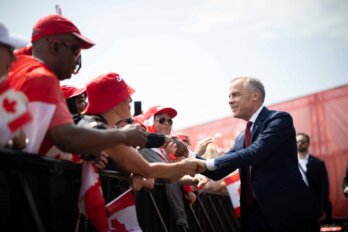
On November 9, I sat down with Manitoba premier Wab Kinew for a fireside chat at Democracy Live in Winnipeg. The talk ranged from the Republican midterm rout to the struggling New Democratic Party to his new initiative to end homelessness.
American journalist Ezra Klein recently described politics as having content and texture. As the leader of the provincial NDP and Canada’s first First Nations premier, Kinew brings content that is largely what you’d expect. He wants to intervene on grocery prices. He wants to build supportive housing. He wants to curb Big Tech’s power. He wants to abolish the Indian Act (okay, so that last bit is surprising). Where Kinew really distinguishes himself is by texture. He’s funny. He likes to make an argument through a story. He relishes a fight but governs as a pragmatist. All this helps Kinew cut a distinctive figure on the Canadian stage and, to some extent, internationally. He has challenged Alberta premier Danielle Smith, weighed in on debates in other provinces, and pushed back against Trump in fairly direct ways. A lot of that texture is on display in this conversation.
This is a forum on democracy. So, in keeping with today’s theme, I want to start with one of the most dramatic verdicts voters have delivered in recent memory. This is the Republican collapse during the midterms. You called it. You predicted Donald Trump would “get slaughtered in the midterms,” and you said that the reason would be because he was completely out of touch with the cost of living. What specifically were you seeing in the run-up to the vote that led you to that conclusion?
Cost of living is the number-one political issue. It usually is, at all times, but especially now. Gas here in Winnipeg was $1.80, $1.90, and the price of groceries always seems to be going up and up and up. Then, at the same time, you had the president go out and say, “Doesn’t matter. Small price to pay for the war in Iran.” Then you had his candidates at the local level say, “One less trip to Starbucks wouldn’t hurt you.” This is let-them-eat-cake territory, right? The verdict Americans delivered was slightly less austere than the one delivered to the person who originally made the cake comment. It just seemed like it was a done deal. As a politician, you typically don’t want the election to be about you. This is a precept of political thought. And yet Trump went around saying, “Act like I’m on the ballot. This election is about me.” So it seemed like a very foreseeable outcome.
His core group, including the person who’s just been appointed White House chief of staff, overestimated what they received by way of a mandate in 2024. They ran against a Democratic Party in disarray. And as a result, they assumed: “We have a mandate for white supremacy. We have a mandate for violence in the streets. We have a mandate for doing whatever we want. We have a mandate that says Donald Trump is infallible.” No, that’s not what happened. You were just running against a weak opponent, and you won by default. So the American people—credit to them—came out and said: “No, we don’t want forever wars. We don’t want people who are lying. We don’t want people militarizing police enforcement to the extent that we’ve seen under Trump’s America.”
What do you think happens next, both in the United States and here in Canada?
I hope to God the Democrats choose a good candidate in 2028. But what the media has gone with is like, “Oh, Trump is done, Trumpism is over.” I think that is too reactionary. I think it will depend on what the Democrats do with the new positions they have in Congress and the governor’s office. And for us, we’re going to be there to try and work with them. Prime Minister Mark Carney has an important job to try and get the tariffs taken off. But it’s going to require a concerted effort of good people trying to push toward the public good.
Do you think the results make it easier or harder for Canadians to get a good trade deal? Part of what I’m curious about happening next in the US is, in fact, a fairly dramatic doubling down by the Trump administration. Putting Stephen Miller in, as you mentioned, is a sign that they’re ready to fight. You said at a press conference in August that a good deal is impossible with a bad person—and that bad person is going to be there for another two years. So, do you think a trade deal is more possible now, or are the odds just as bad?
A trade deal has always been possible, but I don’t think it would be in Canada’s best interest to sign a bad deal. This is the point I’ve tried to make to the prime minister and to the federal government behind the scenes for the past couple of years. Like the press conference you just quoted from—that’s why I made those comments publicly. It’s because I wanted to exert public pressure for us not to capitulate. Since Trump came to power the second time, we’ve seen how much stronger Canada is than perhaps we thought. We’ve seen how much more resilient our Canadian economy is. Unfortunately, we’ve also seen who the collaborators are.
To keep on this theme a bit longer, you’ve distinguished between the Trump administration and the American people, whom you described as friends and neighbours. I’m curious about whether the disruption outlasts Trump, even under a Democratic government. You said that Carney asked premiers to build an economic bridge beyond Trump. But are we just preparing to get through a presidency, or should we be preparing to live with an America that has permanently changed?
I have cousins in northern Minnesota who wear the MAGA hat and Trump clothes. I was asking this cousin of mine, “Why do you do that?” I was curious. Half of it is because he likes Trump, and the other half is because when he puts on the hat and the shirt and goes walking around, people gasp. He’s a full-time troll, basically. He likes it. In northern rural Minnesota, no less. So there’s something telling about that that I think responds to a piece of your question.
But the other piece is that I had this conversation with him at a funeral for our shared aunt. I think that’s the nature of the relationship. There might be people wearing MAGA hats, but we’re still good. The ties that bind are stronger than whatever winds of political change will blow. We’re still going to have friends and family on both sides of the border. We’re still going to have economic interests on both sides of the border. So I do very much think that the relationship is stronger than anything that one administration can do and will outlast the administration.
At the same time, Trump is probably the most consequential president in my lifetime. As a result, he will permanently alter the American landscape. People who were true believers, like Barack Obama in the 2008 to 2016 period, can no longer be true believers. Even on the progressive side of the equation, people have to recognize that democracy is not a static entity. Democracy is something that is always being negotiated or articulated or is being brought into being. And the forces of good might not prevail. The arc bending toward justice—as Martin Luther King Jr. talked about it—that doesn’t happen by accident. That happens by good people getting involved and good people stepping up, good people voting, good people putting their name on the ballot.
Part of the fluidity you mentioned involves something you said after the midterms. You said Canadians were ready to rebuild the relationship with the US. Do you really believe that? Across the way from here, in North Dakota, they haven’t been seeing a lot of Canadians. Crossings fell nearly 24 percent last year. Do you think all that is going to go back to normal after Trump leaves?
Yes and no. I think there’s some people who would like to go on a vacation to an American destination who haven’t recently. I think there’s some people who would like to buy some of the inferior alcohol products that the American manufacturers create. And that’s their right. As with everything, I don’t think it’ll be a binary. I think it’ll be shades of grey.
Going back to the theme of democracy, voters need real choices, and that includes a genuine alternative to the Liberal–Conservative duopoly. That alternative could be, should be, the New Democratic Party—your party. But the federal party you represent is currently adrift. Especially since its collapse in the 2025 election, it has been struggling to make its case with Canadians. But that’s not a problem you have here. Here you’ve built a coalition that includes working-class voters, Indigenous communities, suburban families. A September poll puts you at 60 percent approval rating province wide. So why can the NDP build that kind of support in Winnipeg and struggle so badly federally? What have you figured out that your counterparts haven’t?
Well, you’ve got to get more votes than the other parties. And I think they know that. I love Avi Lewis. His dad was one of my closest mentors and most consequential political figures in my journey from doing The Walrus Talks to throne speeches.
Are you sympathetic to the struggles Lewis is having?
What struggles? I think he’s doing a good job since he’s come in. Tough starting point, but yeah.
He’s the right leader for the job?
I support him—in the sense that I work with everybody. I talk to Pierre Poilievre. I do a press conference with Mark Carney.
Do you think the NDP could be the governing party of Canada one day?
It’s the only reason to be in politics—in elected politics.
The NDP is?
Yes. The federal NDP should win an election. I highly recommend it.
So you’re in politics to manifest that?
No, I wasn’t a partisan until 2016—you know, when I ran for the NDP. I’m in politics to try and manifest a positive change for our province and for our country.
Let’s move on to how you’ve been governing. You lead a progressive government with a fairly interventionist streak, and I want to ask about some of the areas you’ve chosen to step in. Three days ago, the prime minister committed $1 billion in federal funding to Winnipeg, making your province the starting point for his plan to end homelessness in Canada. At The Walrus, we’ve written about your own ambitious efforts to tackle that problem. Help me understand why this is such a priority for you.
Anyone could go down Portage or Main Street or Henderson Highway and see the humanitarian crisis and just feel like we have to do better. What I said at the press conference was, if you can explain something to a child, you’re typically on the right track. And when I go to schools, this is one of the most important issues I hear about. I think it’s a question of dignity and humanitarianism. It’s also a question of fairness in a rich country like Canada. We are one of the richest countries in the world, right? Top seven. And you know you can’t tell me that everyone shouldn’t have a place to stay in a country that’s one of the richest on earth.
On a personal level, I just think about my aunt Nancy. She’s the older sister of the other relative whose funeral I was referring to earlier. She went to St. Mary’s Residential School. She experienced the worst of it—absolute horror stories. So she ran away, and instead of running back to the reserve, which would have been pretty far, she lived in the bush outside of Kenora, Ontario. I think she was about eight at the time this happened. During the day, she’d sneak into town and go dumpster diving to find scraps of food to eat. That’s part of our collective identity as Canadians. And because of what she experienced on the streets of Kenora, she went around giving out food to people who were homeless. She kept doing that well into her nineties, right up until she passed away. I think every tradition has a version of that: there but for the grace of God go I. I’m no smarter or harder working or more talented than my aunt Nancy. She wasn’t allowed to vote when she was young. I was. So, obviously, I had a changing set of opportunities. But at the end of the day, if I was born in a different era, I could have been living in a back lane and dumpster diving. So I feel compelled to help. We can all do better, especially in a rich country.
From a policy perspective, what can you do with Ottawa’s backing that you can’t do on your own?
It’s the housing units—helping us build housing within the confines of a balanced budget. Any political change we make at the provincial level has to be sustainable politically. If we came in and borrowed an exorbitant amount of money and got voted out of office, guess what happens to all the great policy ideas we had for social housing in that one term? Gone. So you have to move in an incremental approach to the extent that the voting public views that you’re still in their corner. This is a lesson Trump forgot, right?
Investing in social services is something we’ve been focused on since we came in—building an outreach team alongside the city of Winnipeg and other municipalities. But for our entire time in office, housing activists have been saying, “You need to build more units; you’re not building enough units.” Our response is, “Well, we’re building.” I think the number is over 500 since coming into office—and that’s from a total standstill. That’s going from zero to 500. But to get to 2,000, 2,500—which is needed to move everyone out of a tent or a shelter—that’s where the federal partnership really, really moves the needle in a dramatic way.
Judging by the coverage of this announcement so far, you would think that the prime minister came here to re-announce something that he’s talked about a million times already. I don’t think we’ve properly appreciated that what was announced on Friday is the biggest investment Manitoba has received in my lifetime. And probably before my lifetime. I’ve seen all these housing co-ops around that were built in the ’60s by a previous federal government. What we’ve seen committed to on Friday is our contemporary equivalent of that scale of intervention. It’s huge.
Tell me about affordability. You’ve made it a defining mandate of your government. You’ve cut the gas tax. You’ve taken the provincial sales tax off grocery items. My question is: Is this a realistic promise for a government to make? Some of the biggest forces driving up costs are largely outside your control: global markets, tariffs, interest rates. How much room do you think a government really has to make life more affordable?
We can act, and we’ve tried to act in the areas that we have influence and jurisdiction over. You named a few, like lowering the actual costs of things. We froze the price of milk too. Then there’s regulatory areas. Unbeknownst to most Canadians, grocery chains were using property controls written into their contracts to prevent competition and, therefore, allow for higher prices. So we eliminated those, and now it appears to have had an effect nationally because the big chains have moved in that direction as well. That’s the kind of affordability that takes time to play out, so hopefully those competitive pressures will deliver lower costs for people.
But I would say that the stuff that’s not within our purview or jurisdiction should be looked at as well by other levels of government. I’ll tell you a story in a roundabout way to make my point. We’re a hockey family. One of the other people we see at the rink all the time is a big Trump guy. Loves Trump, even though he’s Canadian. Until, of course, his business was tariffed, and then: “Oh, I can’t stand Trump,” right? And when the war in Iran hit, this guy was like, “You know what they should do? You know what they should do? All these oil and gas companies—we should just take them over, and we should just make them charge a lower price.” And I was like, “Well, well, well: Mr. Trump Supporter is now a big socialist!” It just shows you how important the cost of living as an issue is—it’ll cut through whatever ideas you had in your head.
But realistically, why are we the breadbasket of the world, and yet grocery chains make more profit than ever, and the average person can’t afford to put food on the table? Why? Why, when we go to the pump, does our gas come from the oil sands in Alberta, and yet we’re paying the price of the Strait of Hormuz? Why? And what’s happening to that money? They’re not facing the increased costs of moving oil and gas that people in the Middle East are facing right now. Where is that money going? Profit. Record profit for the oil and gas sector right now. We, as a province, can’t intervene there. If we did, the pumps would run dry, the store shelves would be empty. But other levels of government can act, and I think they should.
Next: tech. You’ve targeted algorithmic pricing. You’ve rejected a massive data centre. You’ve imposed electricity levies on Big Tech facilities. You’ve banned cellphones in classrooms. You’ve proposed restrictions on children’s access to social media and artificial intelligence. What connects these decisions?
Elon Musk and Mark Zuckerberg are not trustworthy. And Sundar Pichai. I like Aidan Gomez, who’s the head of Cohere in Canada, a Canadian AI firm. This is going to make me sound old, but I remember when the internet came out, and we were promised free everything. We were promised a democracy—a democratization of information, a democratization of knowledge. We were promised everything is going turn into a utopia because of connectivity. You’ll note that the AI firms kind of promised the same thing for the first few months, and then, basically, it always ends up with a couple of out-of-touch billionaires being able to look at the quiet moments that you have before you fall asleep and use that to sell you cheap goods that you don’t really need. I think that’s bad.
This is a talk about democracy. The most important thing we could do for our democracy to save it is to all throw our phones in the garbage. The most important thing we could do to improve education in Manitoba? Everybody, throw your phone in the garbage. We banned it for kids because I’m trying to get re-elected, and I know banning Facebook for you would get me tossed in the garbage. But everything that we’re saying is bad in tech for kids applies equally to you. It’s not like sixteen comes or eighteen comes or twenty-one comes, and then, well, I could never be manipulated by an algorithm. And actually, like, the circadian rhythms in my body are immune to blue light. You see how ridiculous it is, right?
It’s easy for us to make the case as a government that these things, like surveillance capitalism, are bad for children and our children shouldn’t be exploited by them. But I hope people understand that we are making that public-interest argument to everyone in our society. Surveillance capitalism is bad for everyone. We were promised a different vision of technology. I still hope that we can build it. But part of it means reining in the bad stuff, and part of it means being able to seed and incentivize the good stuff. No other sector operates without regulation. Try to refine gasoline. Try to set up a grid for electricity. Try to sell sausage. It’s tons of regulation. So why is this thing that has been designed by thousands of PhDs who understand your inner mental tick-tock—why is that not subject to regulation and subject to review by the public sector?
I think it should be. So I’m a big believer in the promise of technology but also hopefully a healthy-enough skeptic of how it’s been delivered.
Last question: Do you want to be prime minister?
Aren’t you going to ask me about the Indian Act? Jeez.
I think that’s the answer, isn’t it?
No. I’m just a guy with a status card who thinks we should get rid of the Indian Act. You know what I mean? And they should. I was born a human being, and I will be damned if I die an Indian within the meaning of the Indian Act—like it says on my status card. I believe that I’m Anishinaabe. I believe that Anishinaabe people should decide who is Anishinaabe, not the government. I support my chief of council. I think that they should determine what self-determination means for us, not the government. And I believe that the economic horse pulls the social cart, and I think that the barriers that stand in front of economic empowerment for First Nations people should be removed.
So, if you agree with me on any of those, then you agree with me that it’s time to abolish the Indian Act. Of course, we should have consultation and self-determination. But we should not let certain academics and activists and lawyers invoke self-determination and consultation to keep us living and dying under the Indian Act for another generation. It’s 2026. We have flying cars, but we still have the Indian Act.
I don’t think I need to be prime minister to make that happen. I just think it’s going to be a process that’s going to take a few years to play out, and my entire focus is on getting re-elected here in Manitoba next October, or sooner.
This is an edited version of a keynote discussion with Premier Wab Kinew that occurred at Democracy Live in Winnipeg on November 9. The event was a partnership between DXC+, DemocracyXChange, and Canadian Race Relations Foundation.