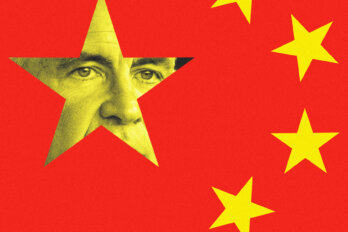
Rockcliffe Park is as lovely a neighbourhood as you can find in this country. It has large, secluded yards and calm, shady streets. Its residents’ stately manors and homes are nestled between the river, forests, and a semi-private lake, which the plebes are only welcome to swim in upon invitation from owners of private docks along its shore. Some of Ottawa’s best private schools claim the neighbourhood as their home, and the residents’ association is certainly one of the city’s best resourced.
Rockcliffe Park also houses a significant portion of the capital’s decision makers and gross domestic product.
The prime minister and governor general live there. The leader of the opposition shares a backyard fence with the high commissioner of India. There are so many diplomats hanging around, their neighbourhood block parties may now have to register on the foreign interference registry. Venerable public servants, a handful of journalists, business leaders, and, of course, lobbyists rub shoulders on the hiking trails or at the sailing club.
In 2024, Mark Carney—then just one of the illustrious members of the Rockcliffe community—was the headliner for the association’s speaker series. He was described by the association president as “our Mark,” before he spoke to a packed fieldhouse crowd, which included Joe Clark as well as probably more members of the Order of Canada than any other room in the nation.
Rockcliffe isn’t the star of this story. I don’t mean to bother the good people who live there. But I happen to be fascinated with the connections between this country’s handful of policy influencers, business people, politicians, media pundits, and moguls who run much of Canada. There are neighbourhoods quite similar to Rockcliffe across the country. Not all of them hold the same level of power, but all share common characteristics: safe and quiet streets, good or excellent infrastructure, access to nature or, at a minimum, ample green space, and a great chance of residents being put in touch with the right people.
I don’t believe any of this is a conspiracy. Rich and influential people have wanted to live among one another since tribes started to settle down in the earliest days of Mesopotamia. But as we experience a widening chasm between what Canadians want and the policies they are being given, I believe there is value in examining where the government is getting their ideas from. And part of the answer, I believe, resides in the circles in which our decision makers exist.
There has been a disconnect for some time between this government’s priorities and those of the average Canadian. The easiest example of this mismatch is on the issue of AI. This government has gone full speed ahead on artificial intelligence, despite Canadians’ apprehensions. Smarter people than I have dug into this better than I ever could, so I won’t say more. But you get it: Carney wants to go in one direction, Canadians disagree, he does it anyway.
In a report on extreme wealth released by the nonprofit Canadians for Tax Fairness, the authors found that “extreme wealth concentration is a problem not because it allows a few people to live lives of luxury, but because of the extreme concentration of power and the corrosion of democracy that can accompany it.” This is true for Rockcliffe but probably even more true in well-to-do Toronto, Calgary, and Vancouver neighbourhoods.
Much as small-c conservatives and their cousins even further to the populist right like to think of themselves as exempt from the Birkenstock-wearing, murse-toting, bicycle-riding, matcha-drinking urbanite intelligentsia, the business leaders they so idolize and seek to please are oftentimes engaged in the neighbourhood associations and business improvement areas which make those well-heeled places so pleasant. My favourite example of this is Jordan Peterson spouting nonsense about the fifteen-minute-cities hysteria when he, in fact, lived and worked in one of the country’s most walkable—and unaffordable—neighbourhoods in Toronto.
The majority of Canadians don’t live in such pleasant environments. Contrary to what European tourists might believe, many of us have never seen a moose or heard a loon call on the way to school. We don’t all universally love nature, because we haven’t all been able to grow up on pristine lakes, and we don’t all ski because getting to the nearest hill without a car (never mind learning how to practise and love the sport) is near impossible.
Proximity doesn’t mean decision makers are corrupt, but it does mean they are sympathetic. And distance can mean the very opposite: once impacts are out of sight, they become out of mind. The Rogers family notably invests in conservation in the Muskokas. Rich people caring about nature around their holiday homes is nothing new. Rich people caring about the well-being of people near their industrial projects, however, would be a novel approach.
Last year, I was asked to speak to decision makers, lobbyists, AI evangelists, and business leaders about whether the Build Canada Act was a good idea. It was a powerful group in which I was, in a room of probably a hundred people, the token environmentalist. I asked the audience to raise their hands if they lived in a rural area. Out of the hundred of us, only one did.
To me, this is significant. The choices that are made in the halls of power, whether by executives or politicians, are determined without much understanding of or consideration for the ground-level repercussions. Those decision makers are furthermore shielded from those decisions by the cartographies of their lives, miles away from any potential impacts generated by the gas turbines, open-pit mines, fracking wastewater, or abandoned oil wells their final investment deals lead to.
I’m not saying this to argue that those who live in calmer, healthier environments have anything to be ashamed of: they don’t. I don’t think it should be viewed as a privilege to avoid, say, childhood asthma. Likewise for access to quality public services. We all deserve them, regardless of income or ability.
But there is a gap with regard to decision makers considering the needs and challenges of places which are not as lovely or as well-endowed as their own.
Shareholders who make a lot of money from, say, oil and gas have a lot to gain from the dismantling of environmental protections. Those folks tend to live in places which will see no observable difference whether megaprojects go forth or not—save for climate change impacts, though air conditioning and secondary homes exist to escape that! For everyone else, those projects mean more noise, more dust, more toxins in the water, and known carcinogens in the air.
These protections exist for a reason, and that reason is simple: businesses, when left to their own devices, don’t give a shit whether the stream you grew up fishing in is a toxic dump, your kids’ brains are poisoned by mercury, or your cabin’s lake becomes a tailings pond. Our legislative and regulatory framework is particularly bad at considering externalities, so we collectively become responsible for the consequences when private proponents go belly up.
But what happens when the proponents are also the people who have propelled a person—say, a minister—into power? What if those individuals supported his foray into politics, fundraised for his party, joined his riding association, let him take a leave of absence from his cushy job, and leaned on their editorial boards to put nice words about his government in the papers? I’m not saying this is true for any one individual politician. But these things happen all the time.
I’d wager that, in this example, it becomes much more challenging for that politician to regulate the industry he is responsible for managing. Especially if he is thinking ahead to his career post-politics, when he will certainly want to regain his powerful status within the industry he temporarily vacated. His former colleagues and friends don’t need to officially lobby him—in fact, lobbying rules prevent it. But those proponents won’t particularly need to sit down with the minister face to face in his Ottawa office. They know him better than that and can make their case in much more informal, pleasant settings.
They might bump into him on a dock or at a fishing camp. Maybe they belong to the same golf club, or they both favour a certain bougie bar. They will definitely send their children to the same schools and so can be expected to meet at sleepovers, pool parties, or birthdays. Better yet, they might be close friends and spend evenings chatting about business and politics around a dining room table or trip. They’ll text. In short: opportunities abound when there is physical or personal proximity between two parties. This removes the need for third-party lobbyists entirely.
I’ve been reading a book about Exxon Mobil, the company that modelled climate change impacts decades before they played out in real time, then proceeded to bury that information and misinform the public about the risks of fossil fuels. A part that stands out to me is the impact of the camaraderie between two key players at the time: Lee Raymond, head of Exxon, and Dick Cheney.
The two had much in common. They were raised in the same part of the country. They were similar in temperament. And they had both attended the University of Wisconsin. I say this not because that means they were born with silver spoons in their mouth—and UWisconsin is far from an elite institution. Rather, I find fascinating the ease with which history ebbs and flows based on small flukes. Had the head of an oil major not attended the alma mater of the vice president of the United States at the precise moment the US administration began paying serious attention to climate change, climate denial may not have taken off so spectacularly.
We’re still dealing with the repercussions of that serendipitous connection today.
That climate is not the number one issue for most people is not a surprise. In a sense, it shouldn’t ever have to get to that level for governments to take note. AI consistently ranks below climate in terms of Canadians’ priorities. Yet the government has released an AI strategy very few of us asked for and is funnelling money and attention to that issue—despite very strong opposition among the population. Why? Because their friends stand to benefit from the AI bubble.
It is a choice not to focus on climate policies, and the rest of us should absolutely be naming it. But when so few actual climate policy experts and champions have access to the clubs, parties, Signal chats, neighbourhood get-togethers, and group runs which form the essential habitat for our government’s decision making, we evidently do not hold much sway next to, say, oil industry top brass or AI bros.
Canada doesn’t need to experience a hostile takeover. The fox is already in the henhouse, and there is very little proof that we are moving meaningfully away from the “Old World Order”—in fact, Carney appears to be welcoming many components of it.
Tobi Lütke’s comments about removing the right to vote from the elderly and low-income people have rightfully received a lot of public denunciation. But Lütke is not some whack-job extremist with a Twitter account. Or rather, he is one, but he is also influential in Ottawa. I heard him (badly) interview Barack Obama back in 2019—at an event hosted by Canada2020, a Liberal-aligned think tank which Mark Carney chaired until he ran for office.
Though it may not be as showy as a Twitter firestorm, Lütke and his band of merry men have been influencing the federal government’s policies since Carney took office. I’ve chatted with some of the folks from Lütke’s “Build Canada” team—I was actually surprised to meet one in the flesh, having wondered whether they were all just AI agents. Unsatisfied to simply be embedded within federal government agencies through their “Build Canada Exchange,” the special interest group also built an AI-powered “Builder MP,” which encourages members of Parliament to vote in favour of the tech industry’s interests and generates slop which living, breathing MPs can use to make their case in committee or in the House of Commons. Carney has cribbed passages from their briefing notes in his speeches. And the list goes on.
The tech industry is going about this very overtly, but they are far from the only industry doing so.
Climate watchdog Environmental Defence released a report last month about how many meetings various cabinet members and high-level officials have held with lobbyists from the oil and gas industry. Their findings are astounding, though not surprising: the industry has lobbied Carney’s government approximately five times a day, surpassing, by far, their efforts under Justin Trudeau’s government.
But these numbers only represent official lobbying, not the efforts led by the government-run Major Projects Office to encourage more oil and gas production (if anyone cares to look into the staff on that team and cross-tabulate them with personal and professional fossil fuel interests, it could make for a fascinating story). They don’t represent the run-ins between Carney, Natural Resources Minister Tim Hodgson, Privy Council officials, or deputy ministers at conferences, running races, at local farmers’ markets, or Canadian Club receptions.
Fundraising and lobbying rules exist for good reason and generally help us avoid the type of overt pay-to-play cronyism we’re seeing on full display south of the border. But the lobbying commissioner can’t regulate neighbourhood block parties, children’s private school attendance, school volleyball teams, concert attendance, or Muskoka cottage bonfires. The proximity of those with money to those in power forms the bedrock of our country’s decision-making apparatus.
It’s all legal: the lobbying and the hobnobbing. I’m not saying the contrary. But when Canadians feel that there is a discrepancy between what they care about and the direction their government is taking, it’s in great part because of this one fact: they have been left out of the cartography of power.
A few years ago, a friend’s partner died from complications of type two diabetes. His funeral was unbearably sad. As I paid my respects, it dawned on me that I knew some of the lobbyists who have, to this day, successfully staved off any meaningful government regulation to reduce the availability of junk food, soft drinks, or the sugar content in food. Those lobbyists are kind, family-oriented, hard-working individuals. I know they didn’t mean to kill men like the one whose funeral I was attending. But, through a succession of decisions made over time by those lobbyists, their clients, and the politicians they built relationships with over the years, they did. It is not their families but those of people like my friends who suffer the consequences.
As if we lived in parallel Canadas.
Originally published as “Parallel Canada” by Alex Cool-Fergus (Substack). Reprinted with permission of the author.